Explain Different Terms Related to Inventory
Inventory Inventory is the merchandise a retail store has on hand. What Are the Four Different Inventory Types.
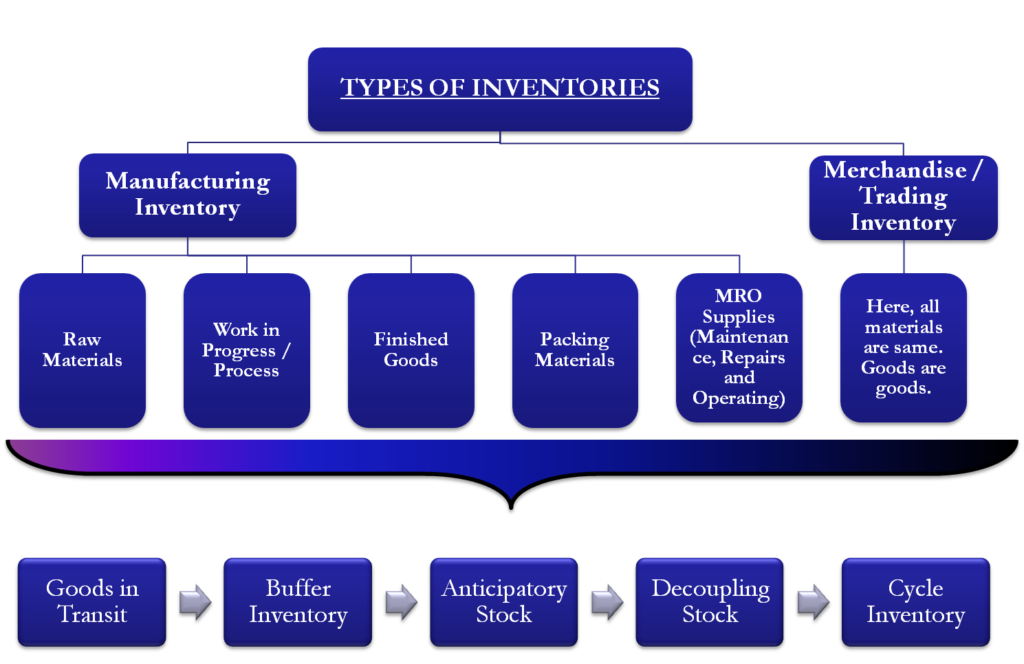
Types Of Inventory Stock Efinancemanagement
Inventory management and supply chain management are the backbone of any business operations.
. Work in progress inventory is the cost accumulated to the goods that are partially completed and the finished goods inventory is the. In accounting inventory is typically broken down into three categories which are as follows. FIFO is a great way to keep inventory fresh.
Inventory Turnover The number of times during a given period that the average inventory on hand is sold and replaced. LIFO or Last-in First-out assumes the newer inventory is typically sold first. Another type is MRO inventories which are to support the whole manufacturing and administrating operation.
There are several possible inventory. A working inventory system cannot exist without these elements. The basic formula for determining the cost of goods sold in an accounting period is.
Defined as the firms investment in selling the inventory they purchased. Ordering holding and shortage costs make up the three main categories of inventory-related costs. With the development of technology and availability of process driven software applications inventory management has undergone revolutionary changes.
Budget force fund pool repertoire reservoir stock supply. Inventory is an idle stock of physical goods that contain economic value and are held in various forms by an organization in its custody awaiting packing processing transformation use or sale in a future point of time. Includes items that are in the midst of the production process and which are not yet in a state ready for sale to customers.
There are four types or stages that are commonly referred to when talking about inventory. Inventories usually make up a large part of the total current assets of a company. Radio Frequency Identification RFID System.
Understanding the different types of inventory is essential for making sound financial and production planning choices. The three types of inventories are direct material inventory work in progress inventory and the finished goods inventory where the direct material inventory includes the stock of raw material which the company has purchased for its use in production. Inventory management is the management and monitoring process of a companys stocked goods inventory.
Some people do not recognize MRO as a type of inventory. Typesclassification of inventory. These groupings broadly separate the many different inventory costs that exist and below we will identify and describe some examples of the different types of cost in each category.
Defined as the firms usage of working capital for goods that they sell. Beginning inventory Purchases - Ending inventory Cost of goods sold. Keep reading Manufacturing Inventory Raw Materials.
Raw materialscomponents WIP finished goods and MRO. Raw materials components and finished products. Many producers partner with retailers to consign their inventory.
Management is compelled to build up excessive inventory for reasons beyond its control as a measure of government price support of commodity as in the case of strategic import. There are 12 different types of inventory. These groupings broadly separate the many different inventory costs that exist and below we will identify and describe some examples of the.
Inventory Understanding Inventory. LIFO helps prevent inventory from going bad. Remember that inventory is.
Based on the value addition or stage of completion the manufacturing inventories are further classified into 3 types of inventory Raw Material Work-In-Progress and Finished Goods. Includes materials intended to be consumed in the production of finished goods. 5 Types of Inventory Costs Ordering holding carrying shortage and spoilage costs make up some of the main categories of inventory-related costs.
However some people recognize only three types of inventory leaving out MRO. It is defined as the array of goods used. Inventory has different classifications at different points in the supply chain.
In the last decade or so we have seen adaptation of enhanced customer. It is the managers job to account for each product and what stage it is currently in. Inventory is a very important asset for any company.
A list of items to be stocked a list of locations where items may be stocked a list of units of measure a list of quantities including the quantity number and unit of. Inventory control systems help you track inventory and provide you with the data you need to control and manage it. The four types of inventory most commonly used are Raw Materials Work-In-Process WIP Finished Goods and Maintenance Repair and Overhaul MRO.
There are four main types of inventory. FIFO or First in First out assumes the older inventory is sold first. Consignment inventory is the.
Safety inventory provides for failures in supplies unexpected spurt in demand ie. You can practice better inventory control and smarter inventory management when you know the type of inventory you have. Raw materials work-in-progress WIP finished goods decoupling inventory safety stock packing materials cycle inventory service inventory transit theoretical excess and maintenance repair and operations MRO.
In business the inventory may be defined as the goods held for sale in the ordinary course of business or the goods that are used to manufacture goods to be sold. Inventory management refers to the process of ordering storing and using a companys inventory. The proper reporting and accounting of inventory increase the usefulness of.
Types of Inventory Management Systems within Inventory Control Systems. Main Inventory Control System Types. Thus the cost of goods sold is largely based on the cost assigned to ending inventory which brings us back to the accounting method used to do so.
Inventory management is vital for supply chain management in online omnichannel and brick-and-mortar businesses and includes ordering and restocking inventory storing inventory adjusting frequency order quantity and inventory. The term also refers to the act of counting itemizing and recording in-stock merchandise or supplies. LIFO and FIFO are methods to determine the cost of inventory.
Results from the rate of inventory sell through to generate working capital to support the prior defined processes. A term to describe the necessary collections of data that are combined to form a fully functional inventory system.

What Is The Complete Process Of Warehouse Management System Warehouse Management Warehouse Management System Supply Chain Management

Estate Personal Property Inventory Form Fresh Inventory Templates For Landlords Being A Landlord Free Word Document Word Template

What Is Inventory Meaning Types Examples Lendingkart

Inventory Management Flowchart Flow Chart Business Process Management Management


Comments
Post a Comment